ExperteninterviewCircularityUsed Electronics
What It Takes to Build Better Circular Pathways for Used Electronics – A Conversation with Laurent Petit
Veröffentlicht am 3. Sep. 20264 min Lesezeit
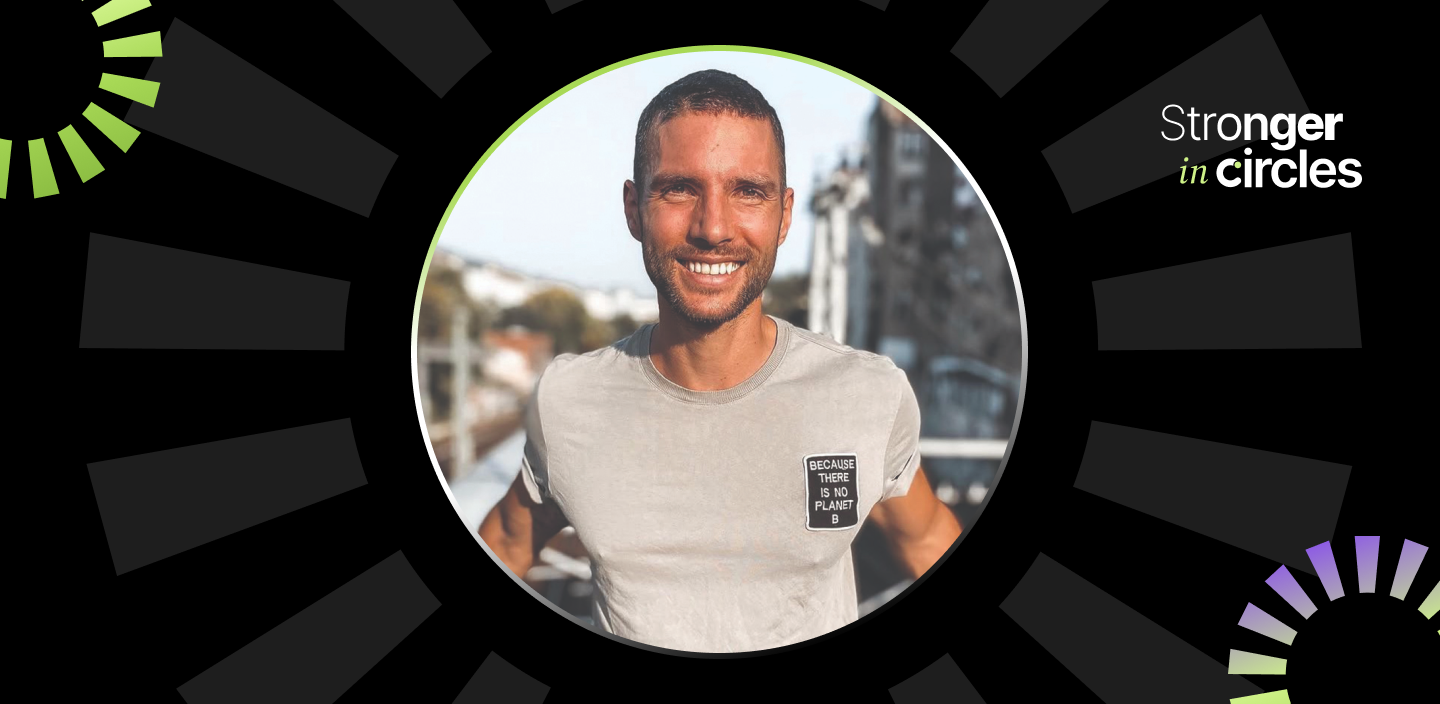
Laurent Petit, Co-Founder & CMO, orbitsandpieces , Co-Founder, Active Giving & ReCircle Impact
With #StrongerInCircles, we want to learn from the people advancing circularity from different perspectives – and make their experiences, challenges and ideas more visible.
For our latest edition, we spoke with Laurent Petit, Co-Founder & CMO of orbitsandpieces, and Co-Founder of Active Giving and ReCircle Impact .
Over the years, Laurent has worked across sports and sustainability, and later expanded his focus to circularity, unused products and e-waste.
What makes his perspective especially interesting is the breadth of that journey – and the way each step has led him to look for practical solutions to very different challenges.
In our conversation, Laurent shares what first brought him into circularity, how building different ventures has shaped his thinking, how orbitsandpieces works to identify suitable next pathways for used electronics, and what he believes needs to change across business, institutions and society for circular models to scale.
Laurent, what was the turning point in your journey that led you to circularity?
Having worked in the sustainability space for over a decade—particularly within sports—I realized early on how inherently non-sustainable and linear the sports industry remains when it comes to product design and waste management. Driven to find tangible solutions, my turning point came in 2024 when I took on a role as a venture builder with Neew Ventures in Berlin. That was my first direct leap into building circularity and waste management solutions for sports, which eventually showed me that these models could be scaled across many other industries as well.
What is Active Giving, and how has the experience of building your first company shaped your drive to co-found new companies and initiatives?
Active Giving is a platform that transforms physical activity into funding for positive climate and social action. Through our app, users log sports or fitness activities, which are then matched by sponsoring brands and organizations to fund initiatives social and environmental projects. Its mission is to increase the level of physical activity in society while creating awareness around the importance of caring for our planet and its people.
Building my first company was a thrilling experience because it showed me how quickly a digital solution can take hold and drive real-world impact. It also made me realize that while Active Giving addresses one specific challenge, there are countless other pain points waiting to be solved, which naturally fueled my drive to keep building new ventures.
At ReCircle Impact, you started looking more closely at unused objects and their potential. What made you focus on e-waste?
We initially focused on decluttering to help people lead more circular lives, starting with sports gear and expanding to general household items like furniture. However, as we explored unused items sitting in basements and drawers, e-waste stood out for two reasons: it is one of the fastest-growing waste streams globally, and it holds tremendous residual value. Focusing on e-waste allowed us to target an urgent environmental problem where circular recovery yields the highest impact and value.
You recently co-founded orbitsandpieces. How does your approach help determine what should happen to used products?
At orbitsandpieces, our goal is to maximize the value of electronic items by identifying the optimal circular pathway, whether that is direct reuse, remanufacturing, harvesting parts, or high-grade recycling. We built an AI-powered sorting engine that analyzes photo inputs of discarded electronics. The platform allows processing and collection facilities to set customized criteria based on their business models, automatically routing each item or component to its highest-value next life.
How do you envision the future of the circular economy? What needs to change at a business, institutional, and societal level?
IMO achieving a circular future requires synchronized momentum across all three fronts:
- Societal: Consumers hold significant power through their daily choices, but ingrained habits from linear consumption models and widespread misinformation make circular living feel inconvenient. But the good news is that solutions already exist, so "it’s just" a matter of giving these solutions more visibility. Through education and incentives. Making the circular way easier and more rewarding than the linear one.
- Institutional: Regulatory bodies must enforce circular design standards and policy frameworks. Cities should integrate circular systems seamlessly into their infrastructure so that sustainable choices are accessible in daily life. IMO cities can be designed with circularity at the center point.
- Business: Companies must move beyond superficial offerings and build viable, circular-by-design business models. I think it’s becoming clearer that there is not only planetary value through circularity but economic ones.
Thank you, Laurent, for your time, your openness and the energy you bring to circularity. We really enjoyed hearing more about the journey behind your work.
Das könnte Dir auch gefallen