Stronger in CirclesExpert InterviewCircular Economy
What taking products apart teaches about why circularity isn’t scaling in Europe - A conversation with Hélène Isermeyer
Veröffentlicht am 29. Juni 20265 min Lesezeit
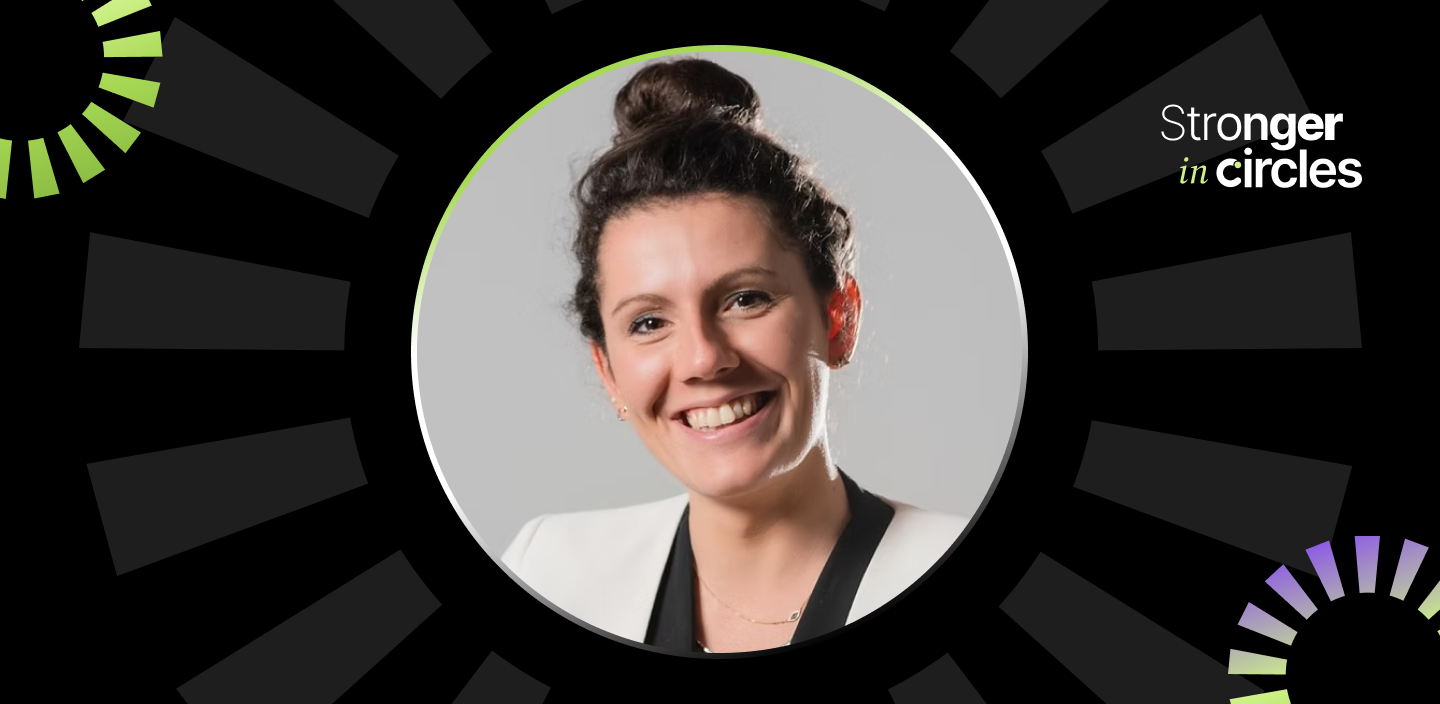
Hélène Isermeyer, MD & Co-Founder Terraquota
Circular economy is no longer only an environmental question.
For the industry, it is increasingly tied to resources, supply chains, costs and long-term competitiveness.
With #StrongerInCircles, we speak with people who bring different perspectives to circular economy and its practical implementation.
For this interview, we spoke with Hélène Isermeyer, Managing Director and Co-Founder of Terraquota. Drawing on her experience across industry, engineering and environmental strategy, she works with manufacturers on circularity, product data and practical decision-making.
In the conversation, she explains why scaling circular economy requires more than technology alone – from product knowledge and eco-design to infrastructure, investment and regulatory certainty.
Hélène, you work at the intersection of engineering, regulation, and environmental science, advising industrials every day. How did you get here, and what made you want to co-found Terraquota?
I started my education in international relations and war studies, which led me to NATO, Airbus, and then Bombardier, where I served as chief of staff. Working on major tenders and rail programs, we were asked a few times to assess the recyclability of our trains and components, and honestly, our first reaction was: “the what?” At the time, recyclability simply wasn’t part of how we thought about our products. But pulling on that single thread led somewhere much bigger, because that one question became our entry point into every other environmental problem and what it means for industry. Keeping the world below 2°C isn’t only about saving the planet; it’s about having access to critical resources and not depending on external countries to keep industry alive: supply chains, resources, costs. War studies, as it turns out, are quite helpful for understanding the geopolitical side of all this.
I also grew up in a family of public servants: military, teachers, nurses, people working with young kids, you name it. These are jobs you don’t do for status or money, but because there’s a purpose and someone has to carry it. That mindset stayed with me, so it made perfect sense to dedicate my work, and a whole company, to a purpose: reducing our GHG emissions and helping industry adapt to a warmer, more uncertain world with Terraquota.
How is Terraquota different from other sustainability consulting firms?
A few things set us apart, I would say: deep industry experience, the mix of profiles in the team, the way we work, and more recently our lab.
We’re not newcomers. TQ was founded by two people with over 30 years of combined experience in industry and its ecosystem, across global steel, aerospace, and rail. We know how it works from the inside, we know the issues it faces (environmental and otherwise), and we have the credibility and skills to solve complex problems that pull on many factors at once: human, technical, commercial, and environmental.
Second, the mix of profiles. Engineers, war studies and environmental policy and business: everyone talks about taking a holistic view of a problem; well, here it is. We don’t operate as specialized departments staffed with identical profiles. We’re one team made of very different ones.
Being small makes us fast(er), so clients often see us as an extension of their own team. We don’t hoard knowledge, we share it, and we don’t just delegate, we roll up our sleeves to build something genuinely useful and understandable for everyone involved.
Then there is the lab. You can’t set a strategy for something you’ve never measured. So we measure your real data, often a mystery even to you, and turn it into decisions that actually move things.
When you physically dismantle a product in your lab, what surprises you most? What do companies typically not know about their own products?
Honestly? The biggest surprise is how much companies don’t know (anymore) about their own products. Even seasoned product managers, people who’ve spent years designing and refining the very same product, are often unsure what some components are actually made of, what their materials are worth, or how easily the thing comes apart. And what I love is that they don’t get defensive about it, because there are good reasons for it now that supply chains are highly globalized. They’re curious. That openness is a gift, because it lets us dig deeper into the product, the materials, and what happens at the end of its life.
It’s not that the knowledge doesn’t exist. It’s that it’s scattered: across sites, functions, IT systems, the entire value chain, with no single place that holds the full picture. Pulling it all together is genuinely hard, and that’s exactly where we and our platform come in. We gather, structure, and consolidate the data points that actually move the needle at the design stage.
And that data isn’t a nice-to-have as many might think it is, it’s the foundation. Try running an LCA without it, or staying competitive without real granularity. An environmental strategy is a pyramid, and this data is the base it stands on. But none of it holds up unless you’re willing to look honestly at how your product really performs. For manufacturers especially, that honesty is everything.
There is a lot of enthusiasm around circularity, but in your experience, what are the fundamental pain points that are still blocking it from working at scale?
Let me start with a telling example. A friend in plastic circularity told us that over the last year, China opened about 1.5 million tonnes of recycling capacity. In Europe, we closed roughly the same amount. That gap is the whole problem in a nutshell. And it isn’t that circularity doesn’t work; it’s that, right now, the economics are stacked against it. Virgin materials stay cheaper, and capital flows to the linear option every time.
For circularity to actually work, four things have to be in place. Right now, we’re short on most of them.
First, resources and skills, because circular economy doesn’t stop at recycling. The hardest part is upstream: eco-design, process engineering, and production optimization, designing products to last and to come apart cleanly, not just repairing something built not to last. That takes a workforce trained across eco-design, materials and chemical engineering, product assembly as much as disassembly, repair, and remanufacturing, plus feedstock clean and consistent enough to process. We have neither at the scale we need.
Second, infrastructure. We need the physical capacity, the sorting plants, recycling lines, and refurbishment hubs, to process our own waste. Today, material that could be recovered ends up exported, downcycled, or sent to landfill simply because there’s nowhere to handle it at volume. And even where the capacity does exist somewhere in the EU, moving waste to it is its own bottleneck: shipping many waste streams across borders inside the bloc still runs through a prior notification and consent procedure that needs sign-off from every authority along the route, origin, transit, and destination, before a single load can move. So the loop stalls twice, once for lack of capacity, and again on the paperwork needed to reach the capacity we do have. On top of that, the pressure is about to grow with the EU’s ban on plastic waste exports to non-OECD countries taking effect in November 2026.
Third, affordable energy and logistics, which is clearly not where we are right now. Going circular doesn’t mean every process can suddenly be clean and green; we still depend on industry to keep running. Collecting, transporting, cleaning, and reprocessing dispersed material is energy-intensive and logistically heavy, so when energy and transport costs are high, as they are now, recycled and refurbished outputs lose on price to virgin materials imported from outside the EU, and border measures like CBAM only reach a handful of materials, not most of these, so the business case collapses.
And fourth, money, which is where all of this comes together. There simply isn’t enough invested in the sector. Circular ventures have longer payback periods and less predictable returns than linear ones, and there’s a broad mistrust of the EU’s secondary-materials market, which is still too unstructured and unproven. Take batteries: we can collect and shred them into black mass, the metal-rich intermediate, but we still lack the downstream refining and cathode-material production to turn it back into battery-grade input here. So it gets shipped abroad for processing and then reimported. The value chain isn’t collocated, so the loop never closes on the continent, capital flows to wherever the processing already exists, and the underinvestment keeps everything else stuck. None of this is inevitable, though.
What would need to change in the next five years for the industry to actually become able to scale circular economy rather than watching it happen elsewhere?
If I can be honest, and risk being a bit provocative: what has to change first is how we manage all of this, because right now it looks like a project run badly. Part of it is that we've been a little too confident, tending to assume that because we once led, we can lead everywhere at once, when the reality is more selective than that. The honest move would be to stop trying to win every race and choose the ones we actually can: design, process engineering, refining, and recycling, the parts of the value chain where Europe still has a real edge. For the rest, we will depend on others, and that is fine, as long as we choose it deliberately instead of sleepwalking into it.
So, first, invest, but with focus: skills, workers, R&D, and the facilities that close the gap with China where it actually matters to us. We gave solar away to China nearly twenty years ago (2006 and their clean energy law) because all we saw was the business case, knowledge included, and we won't win that one back by subsidizing it. The lesson isn't to retreat, it's to invest where we can still build something lasting. And we should be honest that some of what we need we don't have, or won't mine in our own backyard, like the rare earths these industries run on, which is exactly why the choice of where to compete, and where to partner, has to be deliberate.
Second, we need to train the people involved to understand how crucial, vital, and essential this is to their business, on three fronts. There’s the physical risk: climate change (floods, heatwaves, coastal flooding) threatens their very existence over the next 50 years, and if they don’t adapt, they won’t survive, which is really the first meaning of sustainability, to endure. There’s market adaptation: customer demand for more circular products, together with regulatory pressure and compliance, already is and will keep forcing process changes. And there’s the monetary side: circularity isn’t a black hole to pour money into, it can become a real source of value depending on the sector.
Third, decide for the long term, and then hold the line, which is really what regulatory certainty means and it should be a given. To invest and commit, industries need to know what's coming: no OMNIBUS X update every two weeks, no walking back decisions or “simplifying,” no pushing deadlines further out. They need clear guidance, on time, not six months before something takes effect. None of the rest, the investment, the focus, the training, happens without it. If we want circularity to happen in Europe, we have to choose a direction and stick to it.
Thank you, Hélène, for your time, your openness and the thoughtful insights into your work with Terraquota – and into what it takes to make circular economy work in industrial practice.
Das könnte Dir auch gefallen